Your Journey to Serenity Starts Here

Burnout as an Operational Risk: Why It’s Not Just a Wellness Issue
Burnout is often treated as a wellness concern — but it’s an operational risk. Learn how employee burnout impacts productivity, continuity, and long-term organizational performance.
BLOG 3
Mike - Serenity Breeze
2/16/20263 min read
Burnout is often discussed as a personal well-being concern, something to be addressed through resilience training, mindfulness programs, or individual coping strategies. While these approaches may offer short-term relief, they obscure a more consequential reality.
Burnout is not primarily a wellness failure.
It is an operational risk.
When sustained stress becomes normalized within an organization, its effects compound quietly—first in performance, then in engagement, and eventually in retention. By the time burnout is visible, its cost has often already been absorbed across teams and systems.
The Operational Impact of Chronic Stress
Cognitive and organizational research consistently show that prolonged stress degrades the very capabilities organizations depend on most.
Employees experiencing chronic stress demonstrate:
• Reduced decision quality and slower judgment
• Declines in creativity and problem-solving
• Increased error rates and rework
• Lower tolerance for ambiguity and change
These effects are rarely catastrophic in isolation. Instead, they accumulate—introducing friction into workflows, increasing supervision requirements, and eroding trust in decision-making over time.
In knowledge-based and mission-driven work, this degradation directly affects outcomes.
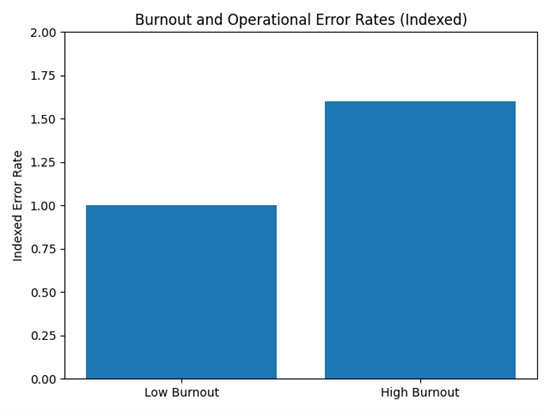
"Chronic stress is associated with higher error rates and reduced decision quality across operational environments."
Sources: Gallup; Harvard Business Review
Employees experiencing high burnout demonstrate meaningfully higher error rates compared to peers with low burnout, introducing hidden operational risk.
Operational failures are often attributed to process or training gaps, when burnout may be a root cause.
Burnout’s Hidden Effect on Teams and Systems
Burnout does not remain contained within individuals.
When one employee’s capacity diminishes, work is redistributed informally. Colleagues absorb additional responsibilities, managers step in to compensate, and systems bend to maintain output. While this adaptability can preserve short-term performance, it accelerates stress across the organization.
Over time, this creates:
• Uneven workload distribution
• Increased interpersonal friction
• Normalization of overextension as a performance expectation
Burnout spreads not because employees lack resilience, but because systems quietly reward endurance over recovery.
From Burnout to Attrition: The Compounding Cost
Employees rarely leave organizations abruptly. Burnout typically precedes disengagement, which precedes turnover.
When employees reach the point of exit, organizations incur costs that extend well beyond recruiting:
• Loss of institutional knowledge
• Disruption to team cohesion
• Reduced productivity during ramp-up
• Increased burden on remaining staff
Even conservative estimates place the full cost of turnover at a significant portion of annual compensation, making burnout prevention not just a cultural priority, but a financial one.
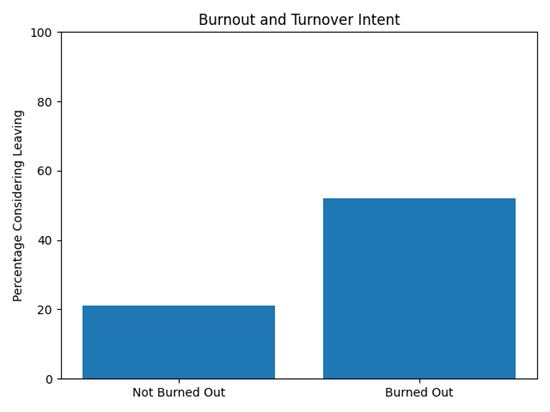
"Burned-out employees are more than twice as likely to consider leaving their organization."
Sources: Gallup; SHRM
Burned-out employees report significantly higher intent to leave, making burnout a leading indicator of future turnover.
Attrition is often treated as a retention problem. In reality, it is frequently a burnout problem that went unaddressed.
Why Traditional Wellness Programs Fall Short
Many organizations attempt to address burnout through isolated wellness initiatives—workshops, apps, or awareness campaigns. While well-intentioned, these approaches often fail to produce lasting change because they do not alter the conditions that created burnout in the first place.
Specifically, they tend to:
• Rely on individual behavior change
• Ignore financial and time constraints
• Leave recovery optional rather than supported
Without structural support, wellness becomes another responsibility layered onto already overextended employees.
Reframing Burnout as a Systems Problem
Burnout is best understood not as a lack of personal resilience, but as a signal of misaligned systems.
Organizations that effectively manage burnout focus less on encouraging employees to cope and more on designing conditions that enable recovery. This includes predictable workloads, psychological safety, and—critically—meaningful time away that actually restores capacity.
Recovery is not a perk. It is a performance requirement.
Designing Recovery into Operations
Burnout persists when recovery is treated as an individual responsibility rather than an organizational design consideration.
Organizations that treat rest as operational infrastructure—not an optional wellness activity—are better positioned to sustain performance over time.
Serenity Breeze Travel exists to support this shift, helping organizations embed recovery into how work is designed, not just how wellness is discussed.
Sources
Gallup – State of the Global Workplace
Harvard Business Review – Burnout and Performance
Society for Human Resource Management (SHRM) – Turnover and Risk