Your Journey to Serenity Starts Here

Retention Is No Longer About Perks — Sustainable Employee Retention
Sustainable employee retention depends on recovery, not just perks. Learn how burnout prevention systems protect performance and long-term engagement at work.
BLOG 5
Mike - Serenity Breeze
3/1/20262 min read
For decades, employee retention strategies have focused on compensation, advancement opportunities, and an expanding menu of perks. While these elements still matter, they no longer explain why employees stay—or why they leave.
Today’s workforce is increasingly evaluating work through a different lens: Is this sustainable?
Why Burnout Accelerates Attrition
Employees rarely leave solely because of pay dissatisfaction. More often, departure is preceded by prolonged exhaustion, disengagement, and a sense that recovery is either discouraged or impossible.
Burnout alters the retention equation by changing how employees assess tradeoffs:
• Short-term loyalty gives way to long-term self-preservation
• Career growth becomes secondary to health and stability
• Exit begins to feel less risky than staying
When recovery feels inaccessible, turnover becomes a rational response rather than a failure of commitment.
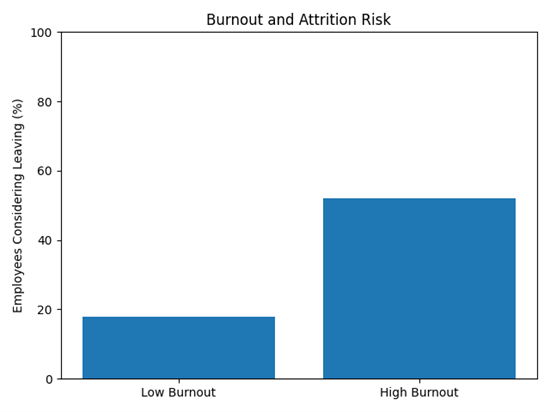
"Employees experiencing burnout are more than twice as likely to consider leaving their organization."
Sources: Gallup; SHRM
Employees reporting high burnout show significantly higher intent to leave compared to those with low burnout.
Attrition is often attributed to compensation gaps, but burnout is a stronger and earlier predictor of exit behavior.
The Limits of Perk-Driven Retention
Perks are designed to signal care, but they often fail to deliver meaningful relief when workloads remain unrelenting.
Common retention initiatives—spot bonuses, flexible schedules, wellness stipends—can temporarily improve morale, yet they rarely address the root issue: employees need consistent opportunities to recover capacity.
Benefits that exist in theory but are difficult to use in practice offer little protection against attrition.
Sustainability as a Retention Strategy
Organizations that retain talent over time increasingly focus on sustainability rather than incentives.
Sustainable work environments share common traits:
• Recovery is normalized rather than exceptional
• Time away is both permitted and practically achievable
• Work intensity is balanced with meaningful disengagement
In these environments, employees are more likely to remain engaged not because they are incentivized to stay, but because staying does not require continuous sacrifice.
Recovery as a Stabilizing Force
When employees regularly experience restorative time away, several retention-related dynamics improve:
• Engagement stabilizes rather than oscillates
• Performance becomes more predictable
• Loyalty strengthens through lived experience, not messaging
Retention improves not because employees feel indulged, but because they feel supported as whole humans capable of sustaining high performance over time.
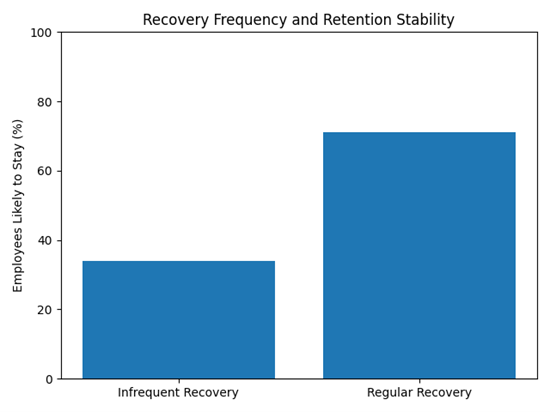
Employees who experience regular recovery are significantly more likely to remain with their employer."
Sources: Gallup; Harvard Business Review
Employees who regularly experience restorative time away report much higher intent to stay than those who do not.
Retention improves when recovery is designed into the work system, not offered as an occasional perk.
Rethinking Retention for the Long Term
Retention strategies that ignore recovery tend to erode quietly, surfacing later as disengagement or sudden departures.
Organizations that design for sustainability recognize that recovery is not an optional benefit—it is a prerequisite for long-term contribution.
Solution: Sustainable Work Requires Sustainable Recovery
Retention efforts increasingly fail when they overlook the role of recovery. Employees do not leave because benefits exist; they leave when benefits are unusable.
Organizations that invest in systems supporting real rest build cultures employees can sustain.
Serenity Breeze Travel is designed to support that sustainability—aligning wellness goals with practical infrastructure that employees can realistically use.
Sources
Gallup – State of the Global Workplace
Society for Human Resource Management (SHRM) – Retention and Turnover
Harvard Business Review – Burnout, Recovery, and Performance