Why Wellness Benefits Fail Without Recovery Infrastructure
Most wellness benefits fail because they rely on encouragement instead of recovery infrastructure. Learn why system design drives sustainable employee retention.
BLOG 6
Mike - Serenity Breeze
3/7/20263 min read
Over the past decade, organizations have invested heavily in employee wellness. Mental health days, mindfulness apps, wellness stipends, and flexible work policies have become common features of modern benefits packages.
Yet burnout, disengagement, and turnover remain persistent—and in many cases, worsening.
This gap between intention and outcome raises a critical question: "Why do so many wellness benefits fail to deliver lasting impact?"
The Limits of Encouragement-Based Wellness
Most wellness initiatives are built on encouragement rather than enablement. They assume employees have the time, energy, and financial flexibility to engage consistently.
In reality, many employees face:
• Financial constraints that limit discretionary spending
• Workloads that leave little cognitive margin
• Planning fatigue that discourages proactive recovery
When stress increases—as it inevitably does—wellness activities are often the first things employees abandon, not because they don’t value them, but because the system does not support follow-through.
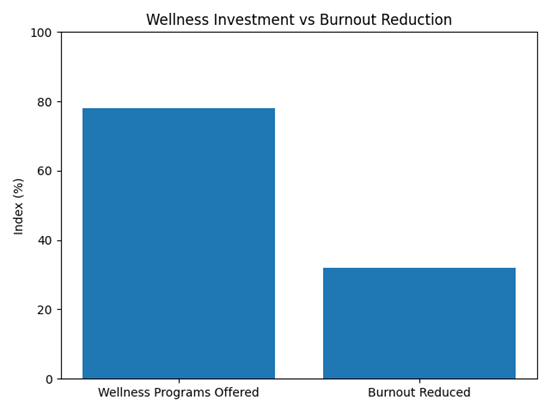
"Despite widespread wellness offerings, burnout and disengagement remain elevated across industries."
Sources: Gallup; SHRM
Organizations may offer numerous wellness programs, yet measurable reductions in burnout remain limited.
Adding benefits without removing barriers produces diminishing returns.
Wellness Without Infrastructure Is Fragile
Benefits that rely on motivation, education, or self-discipline tend to perform poorly under pressure. They add optional activities without removing barriers.
This fragility explains why organizations may offer numerous wellness resources while employees continue to defer vacations, return from PTO exhausted, or disengage altogether.
The issue is not awareness.
It is access and usability.
Why Infrastructure Changes Behavior
Infrastructure works differently from encouragement.
It:
• Reduces decision fatigue
• Normalizes participation
• Makes beneficial behavior the default rather than the exception
This is why payroll deductions outperform voluntary savings, and why healthcare and retirement benefits succeed when they are systematized.
Behavior changes when systems change.
When recovery becomes reliable, the cost of capacity erosion declines.
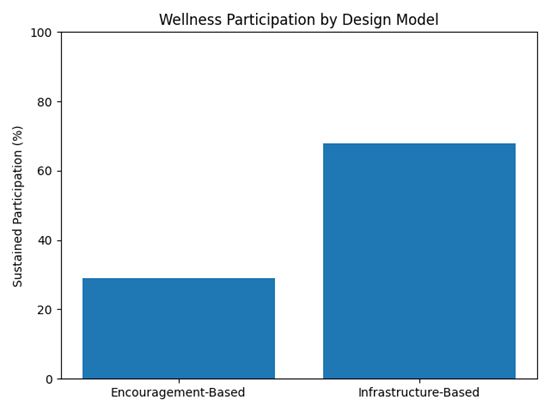
"Infrastructure-based benefits consistently outperform encouragement-based programs in sustained participation."
Sources: Harvard Business Review; Behavioral Economics Research
Benefits designed with built-in infrastructure drive significantly higher sustained engagement than those relying on encouragement alone.
Wellness programs fail when they depend on motivation instead of system design.
Applying Infrastructure to Recovery
Rest and recovery follow the same principle.
When recovery is supported by:
• Dedicated financial mechanisms
• Simplified planning processes
• Cultural permission to disconnect
Employees are more likely to take meaningful time away—and to return genuinely restored.
Without this support, recovery remains aspirational, even in organizations that value wellness deeply.
A New Category of Wellness Benefit
What emerges from this understanding is a shift in how wellness benefits are designed.
Rather than adding more programs, organizations are beginning to invest in recovery infrastructure—systems that make restorative time off practical, predictable, and culturally supported.
This is the category Serenity Breeze Travel was designed to serve.
Serenity Breeze Travel builds the operational infrastructure that enables employees to use their PTO for restorative travel—integrating financial readiness, planning support, and organizational alignment into one system.
The outcome is wellness.
The mechanism is infrastructure.
Designing for Sustainable Performance
Organizations that succeed over the long term recognize that performance cannot be sustained without recovery.
Wellness benefits that endure are not those that ask employees to try harder, but those that make healthy behavior easier.
When recovery is designed into the system, burnout risk declines, engagement stabilizes, and retention improves—not because employees are persuaded to stay, but because staying becomes sustainable.
Organizations exploring recovery infrastructure should begin by assessing how easily employees can convert PTO into true restoration — financially, logistically, and culturally.
If recovery is difficult to access or sustain, the system is incomplete.
Sources
Gallup – State of the Global Workplace
Society for Human Resource Management (SHRM) – Wellness and Engagement
Harvard Business Review – Behavioral Economics and System Design