Your Journey to Serenity Starts Here

From PTO to Recovery — Why Most Time Off Doesn’t Restore Performance
Most PTO fails to restore employee performance because recovery requires psychological detachment, reduced planning friction, and structural support.
BLOG 4
Mike - Serenity Breeze
2/22/20263 min read
Paid time off is often assumed to be synonymous with rest. Yet true recovery—especially recovery from burnout—requires more than time away.
The issue is not that employees fail to take time away. It is that time away does not reliably translate into recovery.
Understanding why requires distinguishing between absence from work and psychological detachment from work.
Why Time Off Alone Is Insufficient
Research in occupational psychology consistently shows that recovery depends less on the number of days away and more on the quality of detachment during that time.
Employees may be officially on PTO while still:
• Monitoring email or messaging platforms
• Mentally rehearsing unresolved work issues
• Managing household or caregiving responsibilities
• Making frequent decisions that mirror work-related cognitive load
When these conditions persist, the body’s stress response remains elevated, limiting the restorative value of time off.
"Psychological detachment is a primary predictor of post-vacation recovery, sleep quality, and sustained performance."
Sources: Harvard Business Review; Journal of Occupational Health Psychology
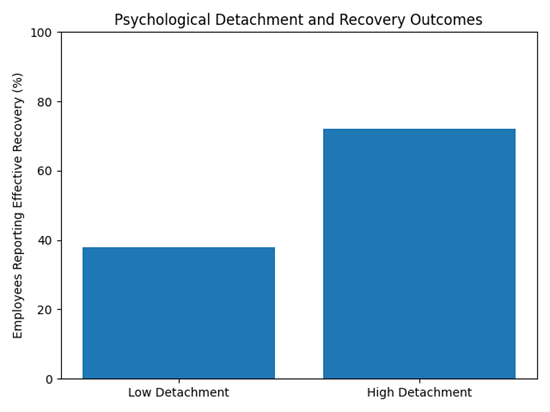
Employees who achieve high psychological detachment during time off report substantially higher recovery outcomes than those who remain mentally connected to work.
Time away without detachment preserves stress activation, limiting the effectiveness of PTO as a recovery mechanism.
The Role of Psychological Detachment
Psychological detachment refers to the ability to mentally disengage from work demands. It is a critical predictor of post-vacation recovery, sleep quality, and sustained performance.
Detachment is more likely to occur when:
• Work communication boundaries are clear
• Decision-making demands decrease
• The environment or routine meaningfully changes
Without these conditions, PTO often functions as a change of schedule rather than a reset of capacity.
Planning Fatigue as a Barrier to Recovery
Ironically, the effort required to plan a vacation can prevent it from happening at all.
Employees frequently describe travel planning as:
• Overwhelming due to too many choices
• Stressful because of price volatility
• Risky due to fear of making costly mistakes
For employees already experiencing burnout, the cognitive effort required to plan a trip can outweigh the perceived benefit of taking one. As a result, many postpone vacations indefinitely or default to low-detachment alternatives.
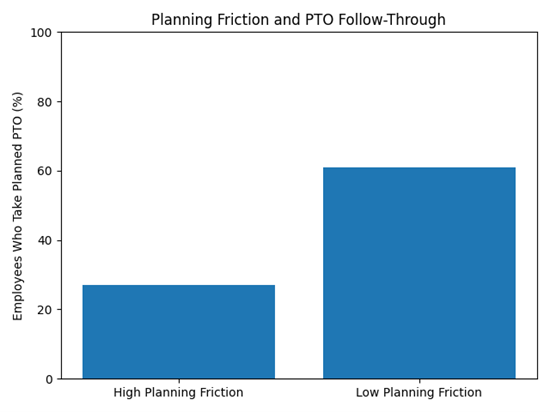
"Planning friction significantly reduces the likelihood that employees follow through on planned PTO."
Sources: U.S. Travel Association; APA
Employees facing high planning friction are far less likely to take planned time off, even when PTO is available.
When planning effort is high, recovery is deferred—regardless of PTO policy generosity.
Why Structure Improves Recovery Outcomes
When time away is supported by structure, recovery becomes more consistent.
Structure reduces:
• Decision fatigue
• Financial uncertainty
• Planning friction
As these barriers fall away, employees are more likely to take longer breaks, disconnect more fully, and return with restored focus and energy.
The effectiveness of PTO, therefore, is not just a policy question—it is a design question.
As explored in Why PTO Alone Fails, time off policies without financial and structural support rarely produce meaningful recovery.
The Organizational Implications of Incomplete Recovery
When PTO does not result in recovery, organizations experience:
• Shortened performance cycles
• Increased error rates
• Persistent disengagement
• Faster return to burnout conditions
As discussed in Burnout Is Not a Wellness Issue — It’s an Operational Risk, incomplete recovery compounds quietly across teams and systems.
Without meaningful recovery, employee performance declines even when PTO policies appear generous. Time off that fails to restore capacity becomes a missed opportunity rather than a benefit realized.
From Time Off to Actual Recovery
When recovery is left to chance, its outcomes are unpredictable. Financial uncertainty, planning friction, and lingering work attachment often undermine the benefits of PTO.
Restorative outcomes improve when time away is intentionally supported, not simply encouraged.
Serenity Breeze Travel provides the structure that helps employees fully disconnect and return restored—turning PTO into a functional recovery mechanism rather than a symbolic one.
Sources
Harvard Business Review – Psychological Detachment and Recovery
Journal of Occupational Health Psychology – Stress Recovery Research
American Psychological Association – Stress in America
U.S. Travel Association – Vacation Behavior and Planning